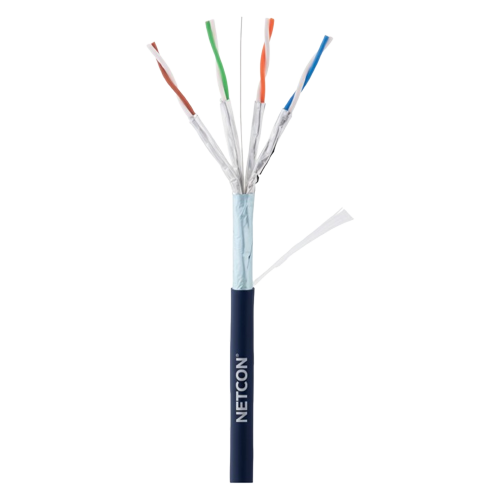
Cat6A Cabling Solutions |Cat 6A U/FTP LSZH/PVC Ethernet Cable
Application Support:
Horizontal and backbone cabling for 10GBASE-T 10 Gigabit Ethernet
Performance Standards:
Complies with ANSI/TIA-568.2-D Category 6A and ISO/IEC 11801 Class EA
Construction Standards:
IEC 61156-5 (Category 6A cables)
EN 50288-4-1 / EN 50288-11-1 (shielded cables – applicable to U/FTP design)
Fire & Safety (LSZH / CPR):
EN 13501-6:2014 (CPR Classification – Cca, Dca, etc.)
IEC 60332-1-2 (Flame propagation)
EN 61034-2 (Smoke density)
EN 60754-1 & EN 60754-2 (Halogen-free / low toxicity)
PoE Capability:
Supports IEEE 802.3bt Type 3 & Type 4 (PoE++ / 4PPoE)
Environmental Compliance:
Fully compliant with RoHS and REACH directiveStandard color - White. Option Available - Blue, Orange, Red, Purple.
Manufactured with AWG23 solid copper conductors and individually foil-shielded twisted pairs (U/FTP), the cable provides excellent NEXT, AXT (alien crosstalk), and return loss performance over extended distances. The pair-wise shielding design ensures effective protection against electromagnetic interference (EMI), delivering stable, high-speed, and interference-free connectivity for VoIP, video conferencing, cloud applications, and high-bandwidth data streaming.
The LSZH (Low Smoke Zero Halogen) outer sheath minimizes smoke emission and eliminates toxic halogen gases in the event of fire, ensuring enhanced safety in offices, hospitals, schools, airports, and public buildings.
This cable complies with international standards such as ISO/IEC 11801, EN 50173, and IEC 60332-1, and can be supplied with CPR-rated classifications (Cca, Dca, or higher) upon request.
Designed for horizontal cabling and patch panel terminations, the Cat6A U/FTP LSZH cable is ideal for fixed installations in structured cabling systems where improved EMI protection is required. It performs optimally in data centers, IT rooms, backbone infrastructure, server racks, and network distribution panels.
The cable supports 10 Gbps data transmission up to 100 meters, ensuring enhanced signal integrity, reduced interference, and long-term reliability for next-generation network infrastructure.